
Divided We Stand: A Polarized Present ... And A Dystopic Future
Archer | CLMI
Approaching its 250th birthday, America feels like two nations sharing one flag. Neighbors become enemies over one or two election cycles. Truth turned into opinion. Social media platforms ablaze with never-ending toxicity and conflict. Conversations turned into battlefields. Media outlets staking claim to ideological positions. Civil disagreements in legislatures breaking out in actual fights. Holiday dinners and family reunions getting uglier. Protests getting more and tense. In every corner of society, from politics to classrooms to family, divisions have replaced any sense of understanding or common ground.
Media profits from outrage, politicians and corporate (or elite family) interests feed on anger, and ordinary people find themselves caught in the middle. As a result, polarization isn’t just a difference of opinion anymore, it’s tearing at the foundation of what it means to be American. In so many respects, we can say that it is American …
If we don’t confront this division now, the America we know could crash into a destructive dystopian reality of fear and control.
Hostile Polarization
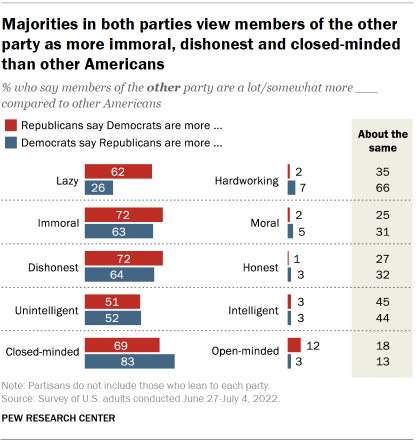
Political factionalism in America continues to grow at rates drawing similarities to the years leading up to the Civil War. Indeed, political antipathy has sharply risen over just several years as Pew Research reveals …
On several traits, majorities of both Republicans and Democrats attribute negative stereotypes to members of the opposing party: An overwhelming majority of Democrats (83%) say Republicans are a lot or somewhat more closed-minded than other Americans, while nearly seven-in-ten Republicans (69%) say the same about Democrats.
Nearly three-quarters of Republicans say Democrats are more immoral (72%) than other Americans, while an identical share (72%) say Democrats are more dishonest. Smaller majorities of Democrats characterize Republicans as more immoral (63%) or more dishonest (64%).
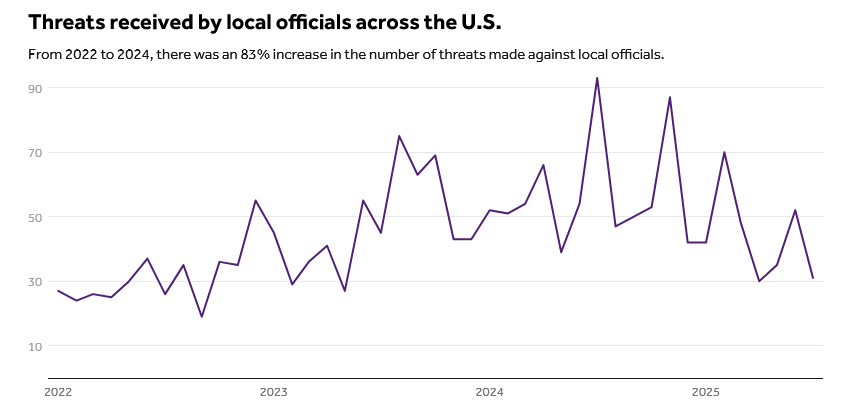
Over time, the division leads to deep mistrust in government according to who’s in charge, how the opposing party is responding to the party in charge, or the lack of productivity by elected officials. That leads to increased protests and, as January 6, 2021 showed, actual armed revolt or insurrection. Many experts point to rising wealth inequality, widespread gun ownership and an underfunded mental health care system as major drivers of instability and aggression. These conditions have fueled an increase in some politically motivated violence. From mass shootings to actual attacks on public officials, showing how dangerous political polarization has become in everyday American life. The number of violent threats toward election officials has risen exponentially, with threats against and harassment of local elected officials increasing 83% between 2022 and 2024, according to the Bridging Divides Initiative at Princeton University.
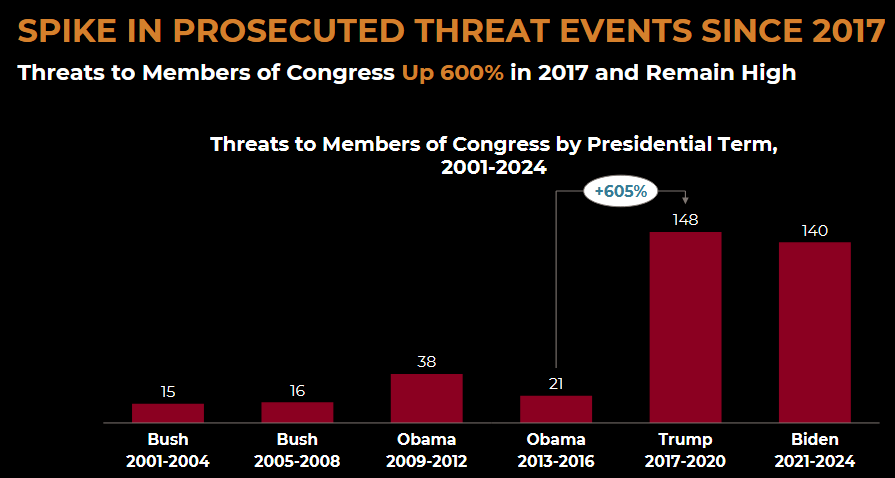
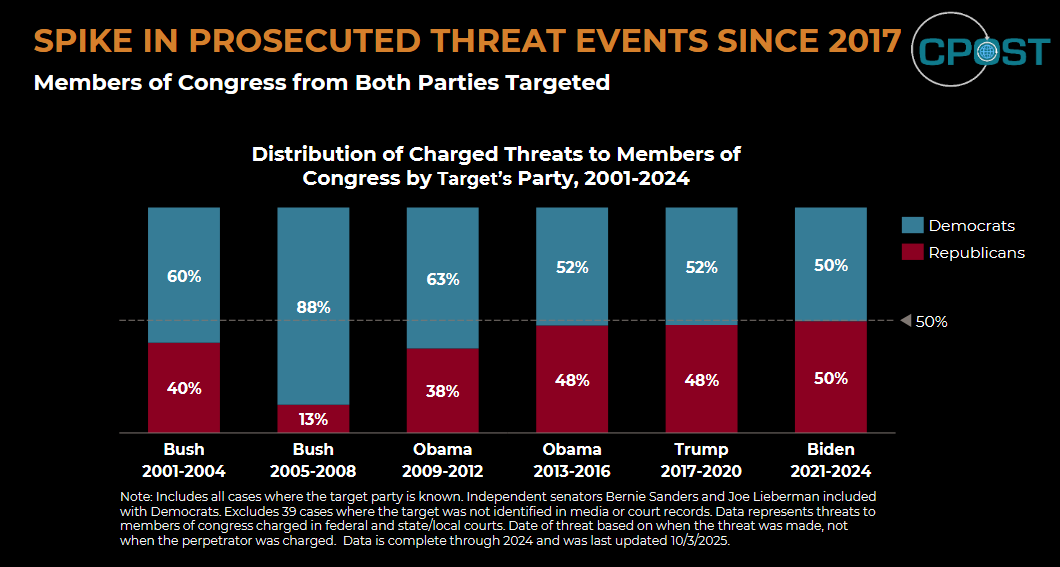
Threats against Members of Congress have also risen dramatically, according to the University of Chicago Project on Security and Threats …
Democrats vs. Republicans
The divide between Democrats and Republicans, of course, has grown so deep that working together feels impossible.
From name-calling debates to constant gridlock in Congress, compromise seems impossible - although some Republicans have recently collaborated with Democrats in the recent push to extend Affordable Care Act subsidies and avoid sharp increases in enrollee healthcare costs. To date, in the House of Representatives, there are 219 Republicans and 212 Democrats and 4 vacant seats. The Senate has 53 Republicans, 45 Democrats, and 2 Independents who both caucus with Democrats. The calculus could swing dramatically, according to pre-election polling, during the 2026 midterms, but there are no guarantees (especially with redistricting battles, and assaults on voting rights and election procedures). Retirements are also on the rise, which could greatly influence the outcomes.
Democrats often focus on progressive policies like civil rights and social welfare programs, while Republicans emphasize traditional values, a strong national defense, and limited government. These differences are not new, but the refusal to meet in the middle has grown worse. Because of party divisions, voters and constituents end up suffering and exasperated, losing faith in their leaders and their government. When loyalty to party matters more than loyalty to truth, democracy starts to crumble. As Christopher Koliba at University of Kansas observes …
[T]he intentional obfuscation of objective facts and the use of falsehoods has been used to manipulate public opinion in liberal democracies like the United States. And while we can and should point fingers at those public leaders who rely on these methods to gain political power, their grip and influence on the populace needs to be understood in the context of the standards that have been established for the government of liberal democracies. The rise of illiberal populist movements have gained followers based in the perpetuation of a “politics of the low” , premised on the overturning of political norms, doctrines and those elites responsible for brokering in truth claims.
Media Control & Manipulation
The media has become one of the biggest forces behind America’s descent into polarization.
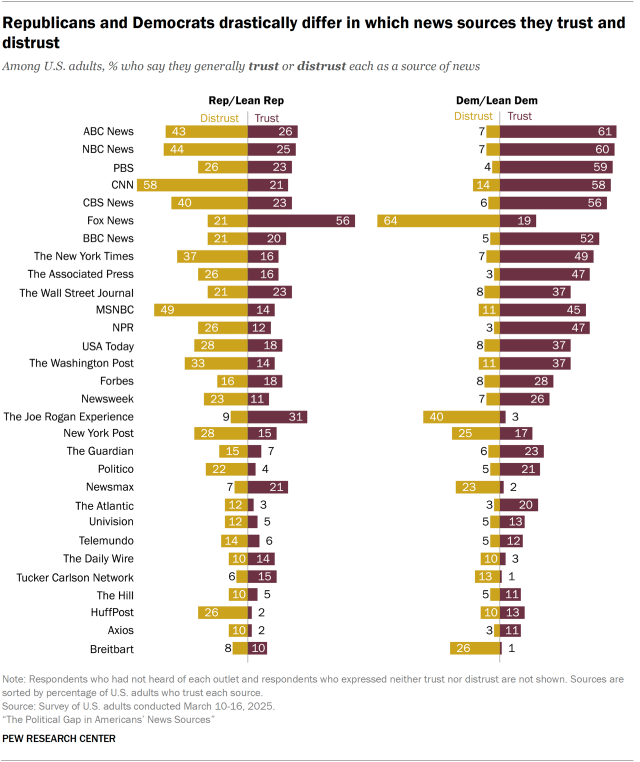
People everywhere turn to different news outlets to understand what is happening. But every news outlet can take the same event and frame it differently. One channel might call a protest a “fight for justice,” while another might label it as a “violent riot.” According to a 2023 Pew Research center study, “ Americans choose news sources that match their political beliefs, deepening the divide between right and left.”
On social media, algorithms push posts that receive the most clicks and reactions rather than the truth. Platforms like TikTok, X, and Facebook keep users inside echo chambers where they only see opinions they already agree with. Research from MIT found that false news spreads up to six times faster online than real information.
ICE Raids & Fear
In many communities, the fear of becoming an ICE victim feels constant beyond just immigration raids. While migrant families do live with the constant worry that an immigration agent could tear them apart from their families without warning, new fears emerge that ICE deployments might expand beyond this, as evidenced by the recent killing of Minneapolis resident Renee Good.
Immigration has become one of the most polarizing issues in America with the political parties pushing their own agendas, including one-sided promises from the right that cause concerns over lack of due process. Republicans often frame ICE raids as a necessity for national security, while Democrats argue they violate basic rights and fuel discrimination. It’s a volatile game of political football.
Dysfunctional or Dystopic?
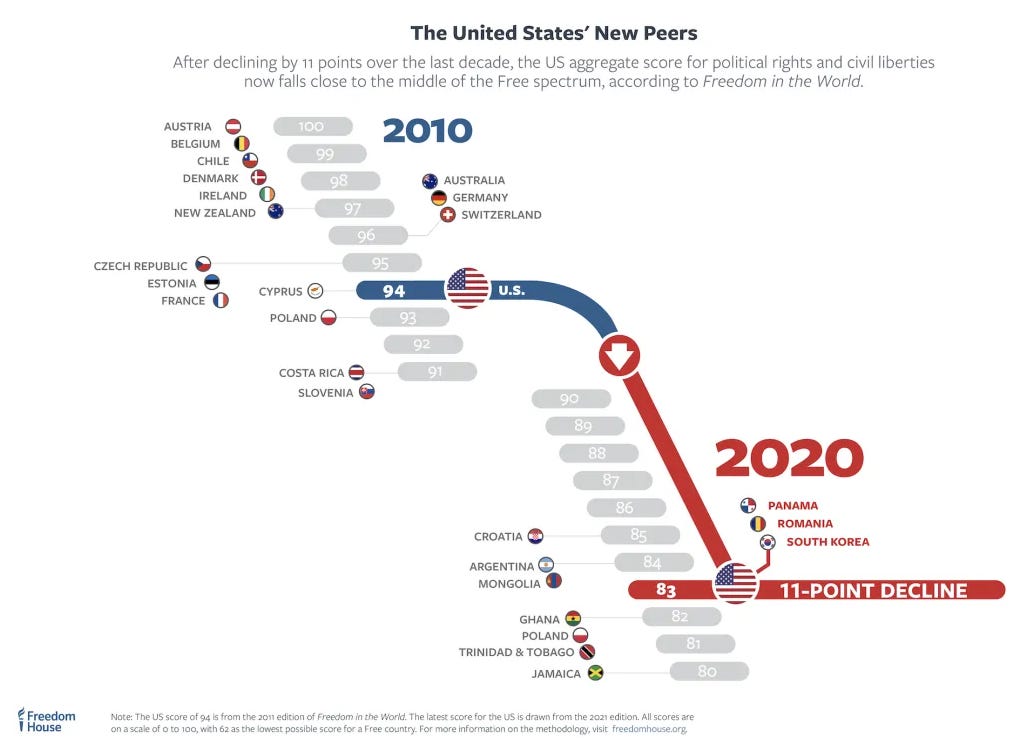
In recent years, concerns have grown that recent trends in the United States could ultimately mirror violent dystopian societies described in science fiction. Many current features reflect existing autocratic societies in Russia, Turkey, Hungary, Argentina and elsewhere. Experts point to increased government surveillance, political division and restrictions on rights in some states as examples. According to The Freedom House’s 2024 report, the US has experienced a gradual decline in its democracy score over the past decade, reflecting growing polarizations and distrust in government. Meanwhile, disinformation, wealth inequality, and social unrest weaken public confidence in government and media.
Solutions Anyone?
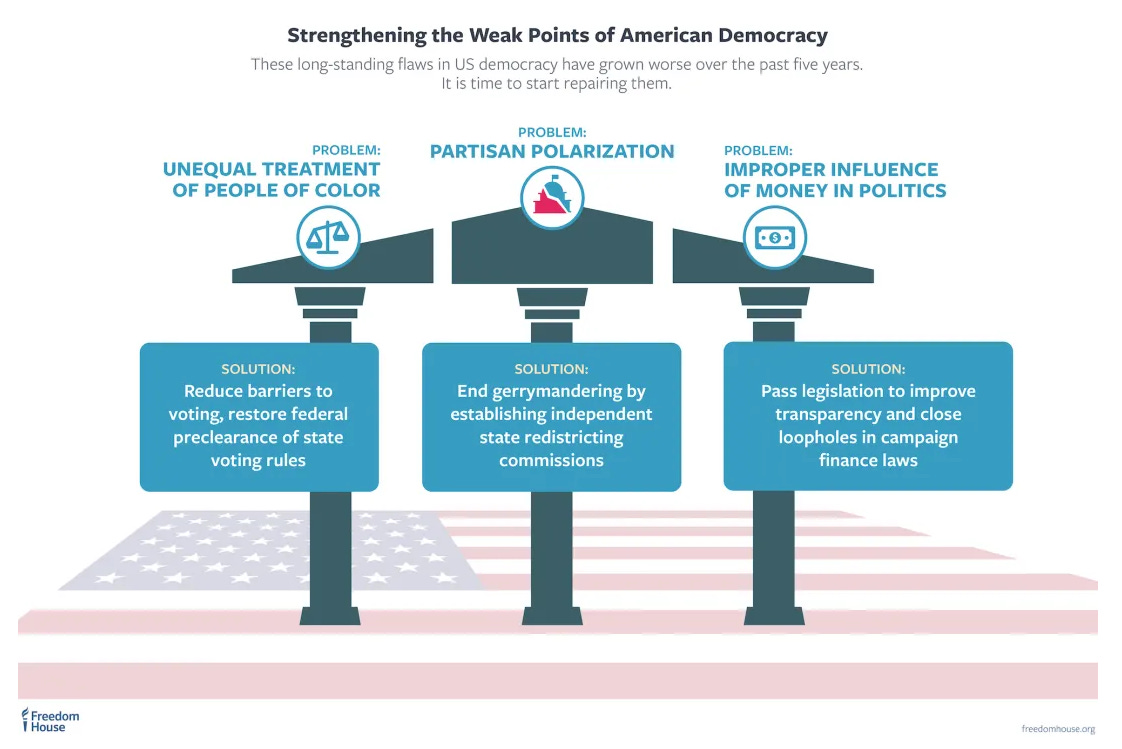
What is the state of our Union … and how do we keep it glued together? Freedom House points to more than several policy and legislative tools at the electorate’s disposal …
But American citizens themselves have easily accessible tools that can effectively counter polarization and maintain democratic values. Voting in local, state and national elections allows citizens to influence government decisions and policies directly. Civic engagement through organizations or local community boards help monitor government actions and promote transparency. Education and media literacy, learning to identify misinformation, fact checking news, and access to multiple sources reduce the influence of biased reporting. Peaceful advocacy, including participation in protests, petitions and town halls, enables citizens to hold their leaders accountable. Additionally, community programs that bring together individuals from diverse backgrounds can promote understanding while dissolving echo chambers. Engagement in these activities strengthens democracy institutions, fosters informed decision-making, and helps protect society from the influence of extremist ideologies.
LOLA ARCHER is a Fellow at the Civic Literacy and Media Influence Institute at Learn4Life

